Matching greenhouse climate control to a mix of crops and site demands is rarely simple for facility managers. Many vendors force you into cloud-only platforms, skip local support, or require custom engineering that outpaces smaller budgets. This comparison defines features, pricing, and service models so facility managers can line up an agency with their project size and support needs.
Table of Contents
- Agricultural Automation Services
- VEK
- Climate Control Systems Inc.
- Ceres Greenhouse Solutions
- Reinders Corporation
- Comparison of alternatives
Agricultural Automation Services
At a Glance
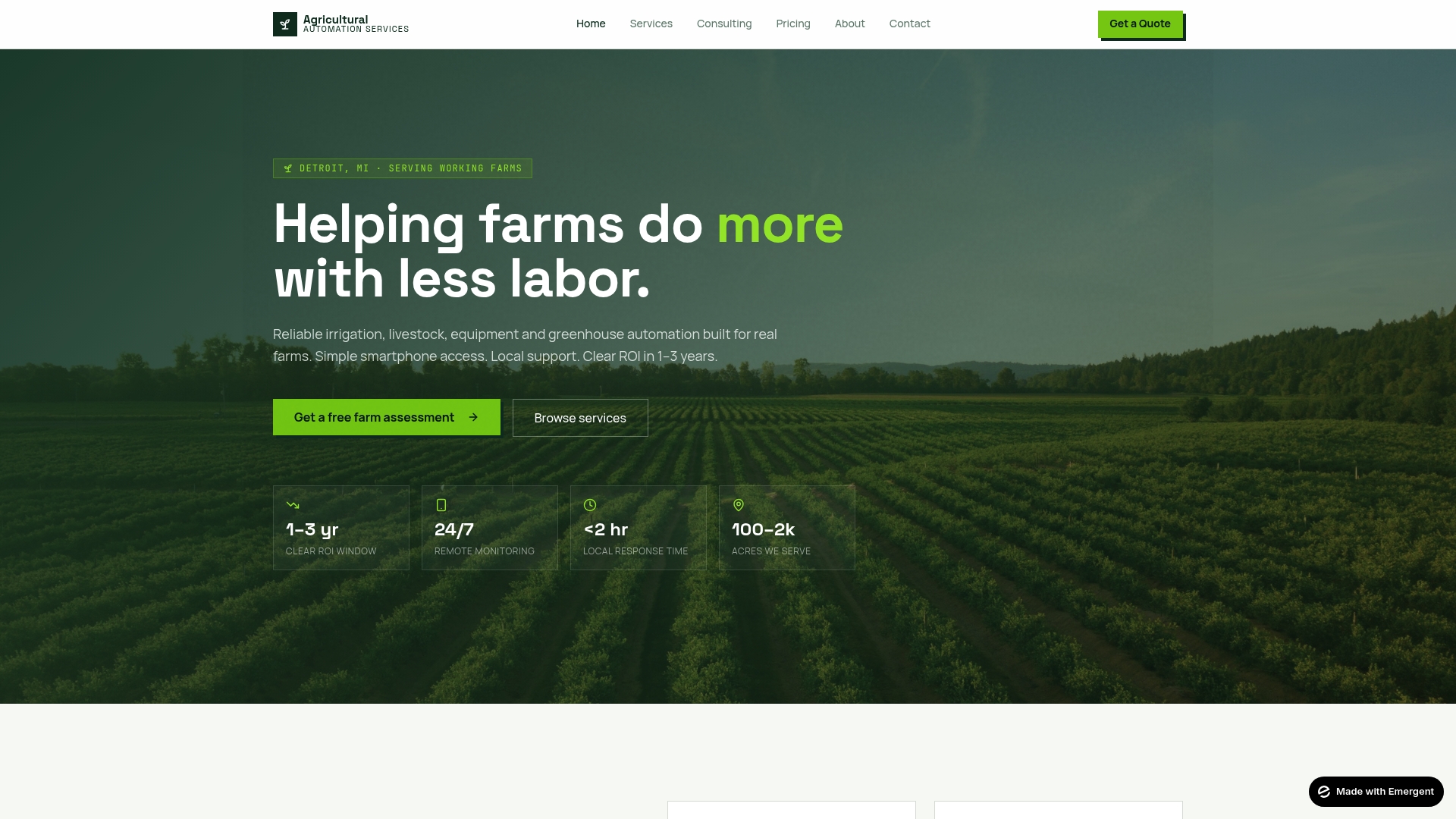
The vendor advertises clear ROI within 1–3 years across a mix of family farms, dairies, greenhouses, orchards, and livestock operations. Agriculturalautomationservices pairs rugged, weather-tested hardware and cellular backups with a simple smartphone dashboard and local Michigan support. The offering covers greenhouse climate control and broader farm automation for both indoor and field operations.
Core Features
Agriculturalautomationservices installs weather-tested hardware with cellular backups and links environmental sensors to a mobile dashboard that sends real-time alerts. The team performs site visits or virtual walkthroughs, produces a gap analysis, and delivers a written report with prioritized recommendations. They also integrate climate and irrigation controls with cultivation management software to unify monitoring, control, and operational data.
Key Differentiator
Local field support combined with hardware built for farm conditions separates this service from cloud-only vendors. Technicians in Michigan offer same-day emergency service and hands-on installation oversight when needed. The vendor favors durable components and predictable subscriptions over adding autonomous machinery or AI features.
Pros
Agriculturalautomationservices brings several practical strengths for commercial growers. The hardware is built to survive outdoor exposure and cellular failover keeps telemetry flowing when Wi Fi drops. Local support in Michigan includes fast service visits and installation oversight, which shortens repair windows. Packages include both on-site design and remote monitoring subscriptions, so you can get installed controls plus a predictable monthly fee. The smartphone interface is focused on clear alerts and simple controls for operators and facility managers.
Cons
- Less suitable for farms seeking purely cloud based or AI driven automation without on-site hardware installations.
Who It's For
This product fits farm owners and facility managers who prioritize reliability and local service over experimental automation features. It suits greenhouse operators, row crop farms, dairies, and livestock producers who plan to install sensors and controllers on site. You should consider this if you want an installed system with phone alerts, hands-on support, and a payback projection tied to real operational savings.
Unique Value Proposition
Tier 1 assessments start at $500–$1,500 and include a site or virtual walkthrough, gap analysis, and a written list of prioritized recommendations. That low entry cost lets you validate needs before committing to a full automation project. After assessment, the team can design and implement climate, irrigation, and sensor networks that connect to cultivation management software and the mobile dashboard.
Real World Use Case
According to the company, a 480-acre row crop farm in Michigan received immediate pump alarms through the monitoring service and recovered costs within one season. The system routed alerts to the farm manager’s phone and reduced time spent checking pumps manually. The installation combined sensors, cellular telemetry, and local support to close the issue quickly.
Pricing
Most installations range from $3,000 to $10,000+ up front, with $50 to $500+ monthly monitoring fees depending on farm size and monitoring tier. The vendor also lists a Design and Implementation range from $3,000 to $15,000+ for larger or multi zone projects. Pricing scales with square footage and project complexity.
Website: https://agriculturalautomationservices.com
VEK
At a Glance
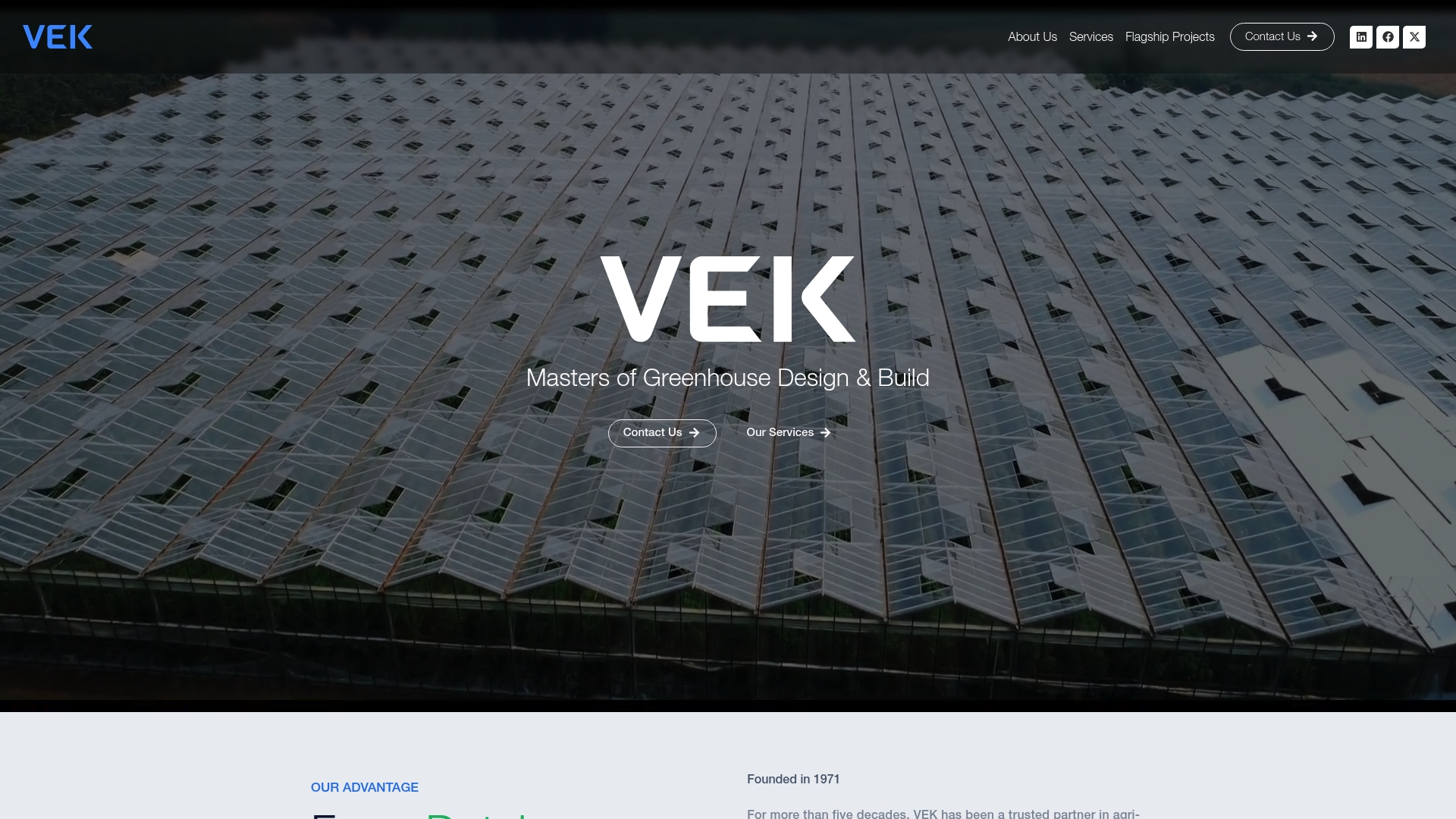
Established in 1971, VEK has designed and delivered climate adaptive greenhouse projects from the World Horti Center to clients worldwide. The company bundles land use planning, feasibility studies, and custom greenhouse construction into single projects. That approach makes VEK suited to large, multi phase developments that move from concept to operation under one lead team.
Core Features
VEK combines holistic land use planning with technical and commercial feasibility work and custom greenhouse design. Projects pair integrated energy, water, and nutrient systems with grower integration and market linkage planning. The firm also runs innovation hubs and R and D pilot facilities to support research and training alongside build projects.
Key Differentiator
VEK centers its work on ecological design principles paired with technical controls to create climate adaptive greenhouse systems. The firm designs integrated resource loops for energy, water, and nutrients so systems operate with fewer external inputs. That blend targets long term resilience and regional food production capacity rather than short term retrofit fixes.
Pros
Decades of international project experience give VEK deep engineering and build competence across climates. The company emphasizes sustainability and regenerative practice in its designs while serving food growers, floriculture clients, and medicinal crop projects. Clients receive planning, construction oversight, and operational handover from a single accountable team. The focus on resource efficiency and climate resilience helps facilities reduce ongoing input needs.
Cons
-
No independent third party review data is publicly available to verify buyer experience or long term operational outcomes.
-
Public site information gives limited pricing detail, so cost clarity requires a direct proposal request.
-
Large projects can become complex and may require substantial planning time and capital commitment.
When It May Not Fit
Small scale growers or operations that need rapid, low cost deployment will likely find VEKs approach mismatched to their needs. Organizations without capacity for extended planning or significant capital allocation may struggle with project timelines. Buyers seeking a fixed price kit style greenhouse should consider simpler suppliers.
Who It's For
Large scale horticultural enterprises, research organizations, government agencies, and investors looking for climate resilient infrastructure will get the most value from VEK. The firm fits groups that plan multi phase projects and want single team accountability from planning through operation. VEK is not aimed at hobby or small commercial growers.
Real World Use Case
VEK designed and built a tomato greenhouse in the Netherlands that combined advanced climate control with integrated energy systems to raise yield while managing resource use. The firm also delivered a research complex in Taiwan for crop innovation and testing. Each project demonstrates VEKs capacity to carry a project from design through construction into operational support.
Pricing
VEK does not publish standard pricing and lists projects as custom and informational only. Final cost depends on project scale, climate variables, and system complexity. You must request a detailed proposal to get an accurate estimate.
Website: https://vek.nl
Climate Control Systems Inc.
At a Glance
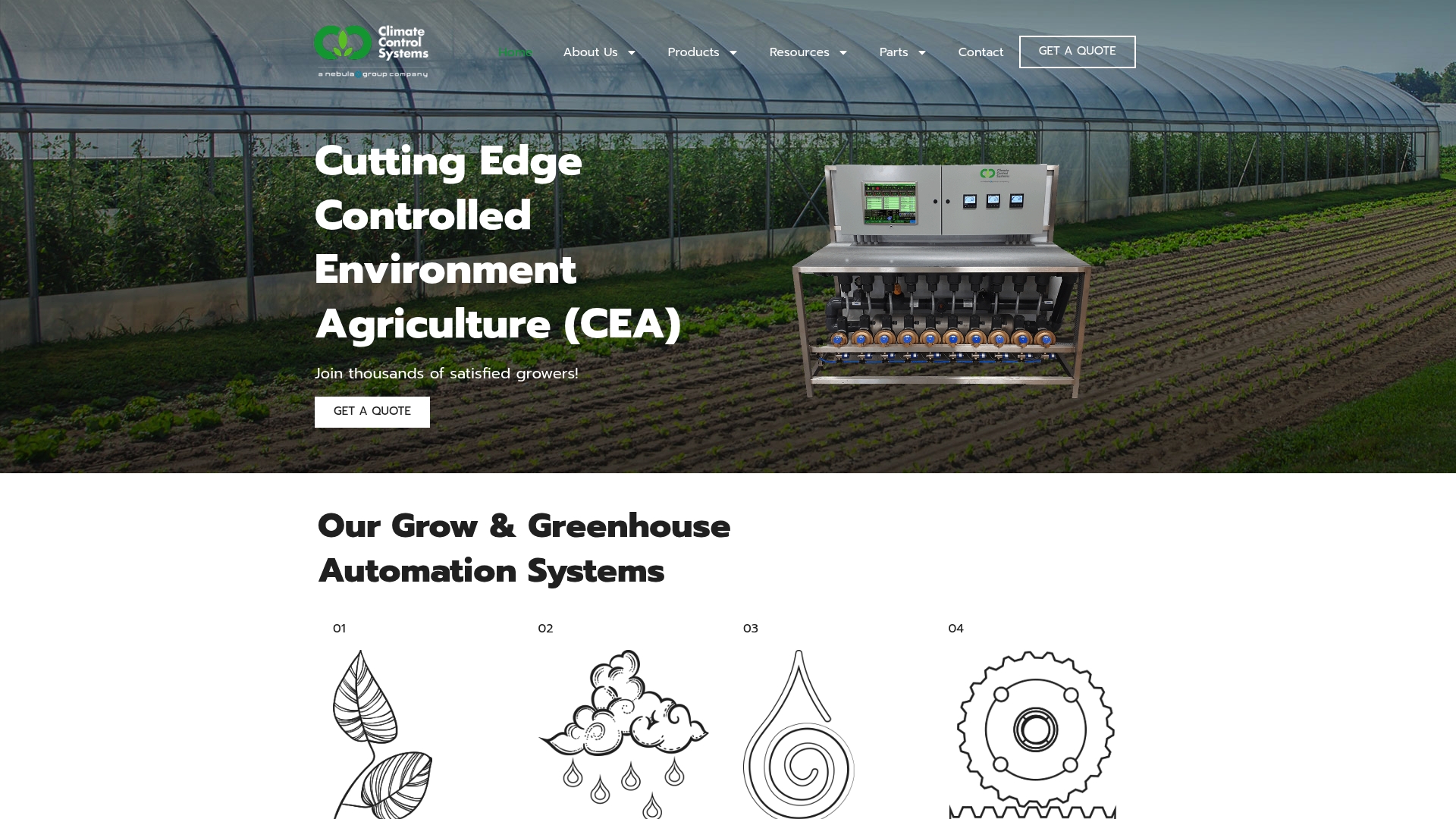
Climate Control Systems Inc. reports a 30–50% reduction in water and fertilizer use after customers pair its Fertigation Manager™ with water recycling. The company has manufactured greenhouse automation systems since 1985 and sells climate, fertigation, and water treatment modules worldwide. Its offering targets commercial operations that need tight resource control and multi-module integration.
Core Features
The software suite controls environmental set points for temperature, humidity, and CO2 while coordinating irrigation and nutrient delivery through Fertigation Manager™. It ties climate regulation to water handling with Climate Manager™ and advanced Water Treatment Systems for sterilization and recycling. The platform also supports mechanical actuation like rack and pinion vent and shade drives and hydroponic irrigation scheduling.
Key Differentiator
The company pairs automation controls with water sterilization and recycling hardware to reduce resource consumption. That combination makes the product attractive to growers who must meet strict water-use targets and who run integrated fertigation and treatment systems.
Pros
Long experience since 1985 gives the vendor deep greenhouse domain knowledge and a broad component portfolio. International installations suggest the company has worked across different climates and regulations. The system is highly customizable for multiple crop types, with specific modules for hydroponic irrigation, rack and pinion venting, and water treatment. The water treatment focus stands out for operations that prioritize reuse and chemical control.
Cons
- Setup and calibration can be complex, requiring trained technicians or vendor support.
- The product is geared toward larger operations and may be expensive for small or hobby growers.
- Integration with older or non-standard controllers can be limited and depends on specific equipment models.
When It May Not Fit
This solution is not a good match for small-scale growers with minimal budgets or for operations that need a plug-and-play controller. Farms that rely on legacy controllers without documented interfaces will face compatibility work and possible extra costs. Operations seeking a lightweight, low-cost controller for a single room should look elsewhere.
Who It's For
Commercial greenhouse operators and vertical farm managers running multi-room or multi-module facilities will find this useful. The software fits teams that can fund installation and hire technical support for calibration. Growers who prioritize water reclamation and centralized control will get the most value.
Real World Use Case
A commercial greenhouse tied Fertigation Manager™ into its water recycling loop and reported a major cut in resource use. The vendor's marketing materials state that figure as 30–50%. That estimate reflects combining precise nutrient dosing with treated reclaimed water while keeping crop quality steady.
Pricing
Pricing is informational only. The company does not list fixed product prices. Project cost depends on facility size, number of modules, and installation complexity and typically requires a custom quote.
Website: https://climatecontrol.com
Ceres Greenhouse Solutions
At a Glance
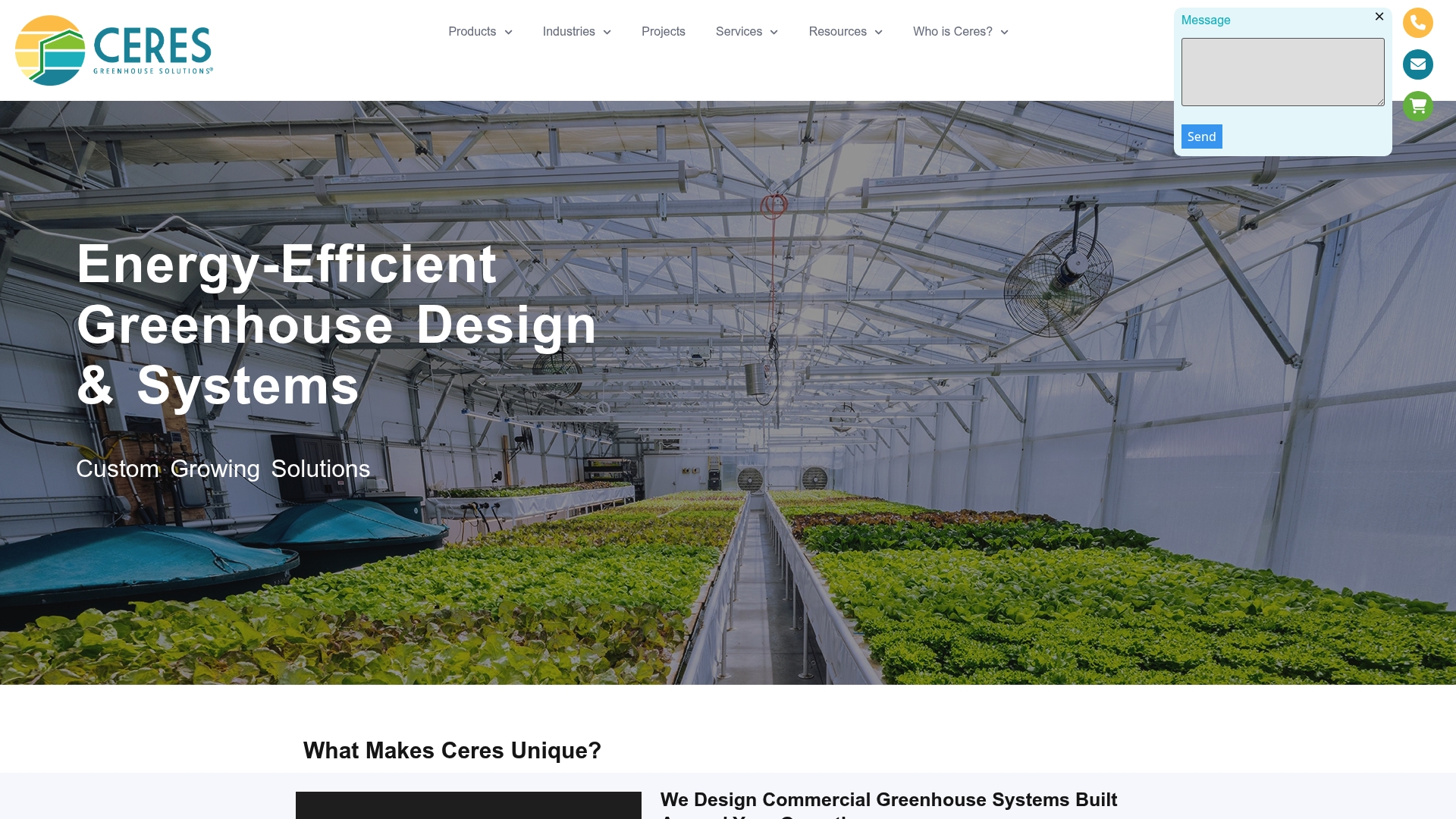
GAHT® ground to air heat exchanger and SunSense™ Controller are central hardware and control elements in Ceres designs. The firm pairs those systems with insulated walls and climate battery technology for energy efficient operation. Clients range from commercial growers to universities and residential projects.
Core Features
Ceres delivers custom greenhouse designs tailored to crop, climate, and operational goals while combining energy efficient building materials and insulated envelopes. Their offerings include a proprietary control stack centered on GAHT® and SunSense™ Controller, plus feasibility studies, engineering, construction support, and operational consulting. The service covers design through handoff so growers get both physical systems and the control logic needed to run them.
Key Differentiator
Ceres ties physical greenhouse construction to its environmental control layer, not just control software alone. That integration means the climate battery, control algorithms, and enclosure are specified together for a single performance target. This approach suits projects that require hardware changes alongside control logic, rather than pure software retrofits. The result focuses on long term resource reduction and operational consistency for the finished facility.
Pros
Highly customizable designs let teams match structural choices and control strategies to a crop and a local climate. The paired use of a ground to air heat exchanger and a programmable controller helps reduce heating loads when implemented correctly. End to end services from feasibility study to operational consulting reduce vendor handoffs and simplify accountability for a build. The company emphasizes energy efficiency and long term scalability in its project planning.
Cons
- Specific scenarios where simple, off the shelf greenhouse structures suffice are not clearly documented by third party reviews.
- Custom solutions require extensive planning and capital, which can push small operations beyond their budget.
- Public pricing is not published; quotes appear to be tailored to each project scope.
- Complex projects may need longer development timelines because of bespoke engineering and site work.
When It May Not Fit
If you operate a small urban farm with limited capital, a custom build may be the wrong scale. If you need a quick, low cost greenhouse for seasonal production, off the shelf structures are likely more appropriate. If your priority is a pure software control upgrade without any construction, this vendor focuses on integrated builds. Projects with tight deadlines should plan for longer delivery windows when customization is involved.
Notable Integrations
- GAHT® climate battery system: soil based thermal exchange hardware that pairs with the control stack.
- SunSense™ environmental control system: on site controller that manages ventilation, heating, and scheduled set points.
Who It's For
Organizations and individuals planning large scale or custom greenhouse projects that target energy savings and long term operation will benefit most. Research institutions and educational campuses that need purpose built test beds fit the model well. Residential clients seeking integrated living plus grow spaces also match Ceres expertise.
Real World Use Case
A university commissioned a climate responsive greenhouse with Ceres systems for year round research and teaching. The project combined the GAHT system with a tailored enclosure and control schedules to lower heating needs. Campus staff reported easier experiment scheduling and more stable environmental set points after the handoff.
Pricing
Public pricing is not listed. Ceres states that project quotes are tailored to site size, complexity, and specification choices, so expect a consult based proposal and a project based fee structure.
Website: https://ceresgs.com
Reinders Corporation
At a Glance
Patented greenhouse air distribution hoses give Reinders Corporation a distinct mechanical edge for even airflow across long benches and multi-span houses. The company traces more than 110 years of operations and serves customers in over 100 countries. That legacy supports hands-on engineering for both greenhouse climate control and heavy industrial air treatment.
Core Features
Reinders bundles custom climate hardware with control-oriented design that targets temperature, humidity, and air movement in large facilities. Their offerings list includes industrial dehumidifiers, humidifiers, and air handling units that pair with greenhouse distribution systems. The product set centers on engineered, site-specific designs rather than off-the-shelf controllers.
Key Differentiator
The standout is the combination of patented greenhouse air distribution hoses and custom-engineered climate units designed for precise environmental regulation. That mechanical design focus lets integrators shape airflow patterns for uniform crop zones and tight humidity control.
Pros
Reinders brings a century-plus track record and large-scale project references to custom climate work. Their global footprint and cross-industry experience mean the engineering team has solved unusual ventilation and moisture control problems across horticulture, pharmaceuticals, and food storage. The company’s strength is custom engineering, which lets growers get units sized and tuned to specific greenhouse geometry and production goals.
Cons
- No transparent publicly listed pricing. This prevents quick vendor cost comparisons.
- Limited publicly available details on third-party software integrations or automation features. Purchasers will need direct technical conversations to confirm control compatibility.
- The offering targets B2B industrial and agricultural clients. Small growers and individual consumers will likely find the scope and minimum project size unsuitable.
When It May Not Fit
If you run a small single-span greenhouse with off-the-shelf controllers, Reinders’ custom engineering approach may be overkill. Facilities that require clear, documented software APIs for existing farm management systems should verify integration options first. The company’s public materials do not detail ready-made automation or software platform connectors.
Who It's For
Large commercial greenhouse operators and industrial facilities that need engineered climate solutions will get the most value. Operators with complex layouts, high humidity sensitivity, or nonstandard air handling needs benefit from custom designs. This suits teams ready to engage an engineering partner for a project-based implementation.
Real World Use Case
A commercial greenhouse installs Enerdes climate systems with Reinders distribution hoses to reduce hot and cold pockets across long tables. Engineers size air handlers and configure ducting to maintain uniform temperature and humidity across benchtops. The result supports tighter crop uniformity and easier climate setpoint management for the production team.
Pricing
Pricing is not publicly listed and the vendor describes offerings as informational only. Expect project-based quotes that scale with facility size and the degree of custom engineering required.
Website: https://reinders-corporation.com
Comparison of alternatives
Agricultural Automation Services distinguishes itself through its reliable local support paired with durable, farm-oriented hardware installations. When compared to other providers, differences emerge regarding suitability for varying operational scales, technology integration, and project timelines.
Where Eco-Friendly Planning Excels
VEK demonstrates leadership in orchestrating large-scale, eco-focused, and custom greenhouse infrastructures. Their emphasis on long-term resilience through energy-efficient, resource-integrated designs appeals to governments, institutions, and growers planning for multi-phase initiatives.
When Hardware Integration Matters Most
Climate Control Systems Inc. delivers fertigation and climate management capabilities, integrating water sterilization and recycling modules. This feature caters to greenhouse operators aiming for precise automated environmental controls and stringent water management, a significant advantage for facilities prioritizing sustainability.
Best fit
- Farms needing local hands-on support can rely on Agricultural Automation Services for turnkey environmental control systems with Michigan-based service reliability.
- Large horticultural operations requiring eco-focused multi-phase greenhouse planning should engage with VEK for integrated development from design through operation.
- Greenhouses prioritizing water treatment and fertigation integration will benefit from the Climate Control Systems Inc. suite, tailored for resource-efficient growing.
- Custom installations targeting energy efficiency and bespoke usability will find Ceres Greenhouse Solutions’ end-to-end processes appealing.
Our pick
Agricultural Automation Services is the recommended choice for operations needing localized service and proven hardware durability. It’s suitable for facilities seeking reliable environmental control paired with practical implementation. For organizations prioritizing advanced ecological planning or water resource systems, other providers may offer specific advantages depending on the project scope and resource constraints.
Farmers and greenhouse operators selecting commercial greenhouse control systems should evaluate options based on installation scalability, technology integration, and service support to determine the solution that aligns best with their operational requirements.
**| Product Name | Key Features | Differentiator | Best For | Price | Limitation | |-----------------------------------|-----------------------------------------------------------|------------------------------------------------|-----------------------------------|----------------------|-------------------------------------------------| | Agriculturalautomationservices | Weather-robust hardware with cellular backup, onsite support, integration with software solutions | Local field support and durability enhanced | Greenhouse operators and large farms | $3,000–$10,000+ upfront, $50–$500+ monthly | Less suitable for purely cloud-based setups | | VEK | Land-use planning, feasibility studies, sustainable designs | Ecological principles and integrated systems | Long-term, large-scale projects | Price not published | Requires substantial planning time and budget | | Climate Control Systems Inc. | Climate, irrigation, and fertigation management, modular hardware designs | Water reclamation with fertigation systems | Large greenhouses with strict resource control | Price not published | Setup can be complex; targeted at larger operations | | Ceres Greenhouse Solutions | Custom builds, GAHT climate batteries, energy-efficient controls | Hardware integrated with control logic | Energy-efficient, custom greenhouse projects | Price not published | Customization can extend project timelines | | Reinders Corporation | Advanced air distribution, custom climate solutions | Unique air distribution hoses and engineering | Commercial and industrial greenhouses | Price not published | Not suitable for small operations |
Choosing reliable commercial greenhouse control systems for your operation
Managing consistent crop environments requires tough hardware that thrives outdoors and a support team that responds fast. Agriculturalautomationservices meets those needs by delivering rugged, weather-tested sensors and controls backed by local Michigan technicians. Their systems unify climate, irrigation, and sensor data on a simple mobile dashboard to alert you in real time and reduce labor costs.
Farm owners and facility managers who want an installed solution with clear ROI and hands-on support will find value in Agriculturalautomationservices. They offer a low-commitment Tier 1 assessment to identify your automation gaps and a Tier 2 design and implementation service tailored to your farm size. To explore how built-for-farm automation can lower risks and improve monitoring, visit Agriculturalautomationservices and learn more about their assessment services.
Take the next step toward dependable automation with a no-pressure plan that fits your commercial greenhouse needs.
FAQ
What features does Agriculturalautomationservices provide for greenhouse automation?
Agriculturalautomationservices installs weather-tested hardware with cellular backups linked to a mobile dashboard that sends real-time alerts. This system allows for effective monitoring and management of environmental conditions, ensuring reliable operation in various climates. You can expect hands-on support and detailed implementation guidance to enhance your facility's automation.
How does Agriculturalautomationservices compare to Climate Control Systems Inc.?
Climate Control Systems Inc. excels at providing greenhouse automation systems paired with comprehensive water treatment solutions. Agriculturalautomationservices, on the other hand, stands out with its focus on durable, weather-tested components designed for local agricultural conditions. This makes Agriculturalautomationservices a better choice for those looking for rugged reliability and hands-on local support in Michigan.
Which automation service is better for immediate support, Agriculturalautomationservices or VEK?
Agriculturalautomationservices offers same-day emergency service and local support based in Michigan, enhancing its responsiveness to urgent needs. VEK, while it provides strong capabilities in large-scale projects, may not match the immediate accessibility of Agriculturalautomationservices when it comes to urgent service requirements. Opt for Agriculturalautomationservices to ensure you have local, prompt assistance when needed.
Can Agriculturalautomationservices support complex multi-zone projects?
Agriculturalautomationservices can effectively design and implement automation for complex multi-zone projects with clear ROIs tied to operational savings. Their service includes thorough site assessments and tailored recommendations for your specific needs, providing you with a reliable roadmap to follow. This makes it a strong option for farms looking to manage multiple environments concurrently.
What kind of pricing can I expect with Agriculturalautomationservices?
Most installations with Agriculturalautomationservices range from $3,000 to $10,000+ up front, with monthly monitoring fees from $50 to $500+ based on farm size and complexity. This structure allows for clear budgeting as you scale automation efforts in your greenhouse operations.