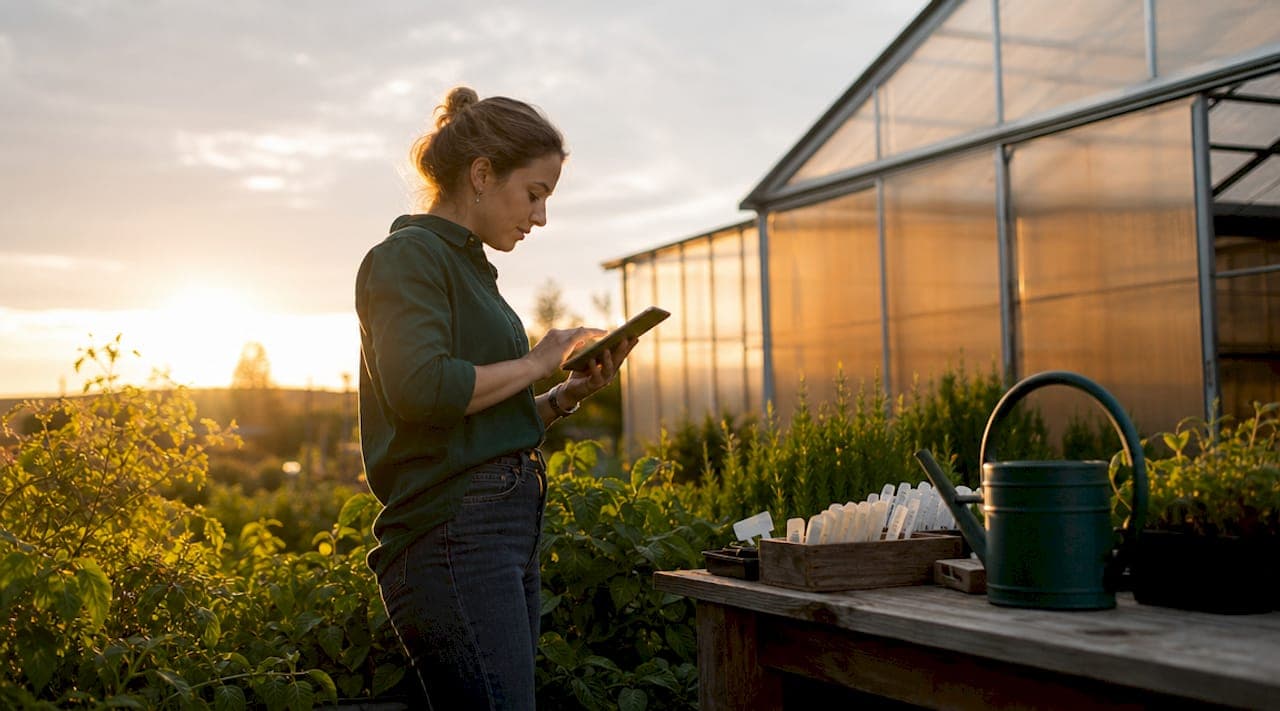
Real-time monitoring is defined as the continuous, live tracking of environmental and operational data with total system latency under 2 seconds from sensor detection to dashboard visualization. For Michigan growers managing greenhouses, vertical farms, or indoor grow operations, this distinction matters more than most realize. A system that updates every 30 seconds is not real-time. It is a delayed snapshot, and in a controlled environment, 30 seconds is enough time for a CO2 spike or temperature swing to stress an entire crop zone. The industry term for what most growers actually need is continuous performance tracking, and the technical bar for it is higher than most entry-level monitoring tools deliver.
What are the technical standards for real-time monitoring in agriculture?
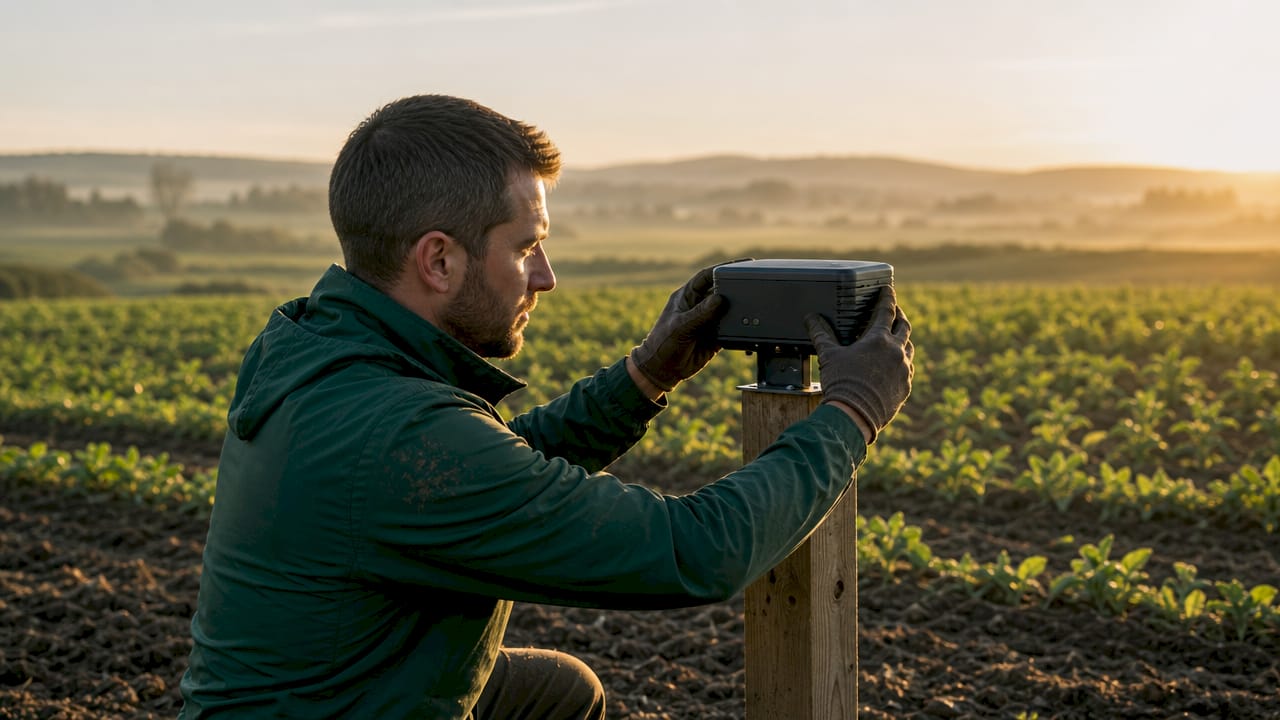
Professional monitoring systems in 2026 require data update intervals of 1–2 seconds with total end-to-end latency under 2 seconds. That benchmark exists because crop stress events, equipment failures, and irrigation faults can develop and resolve within a single minute. A system that misses them is not protecting your yield.
The industry draws a clear line between two performance tiers:
| Category | Latency | Use case fit |
|---|---|---|
| True real-time | 1–2 seconds | Precision climate and irrigation control |
| Near real-time | 5–30 seconds | General trend reporting, non-critical alerts |
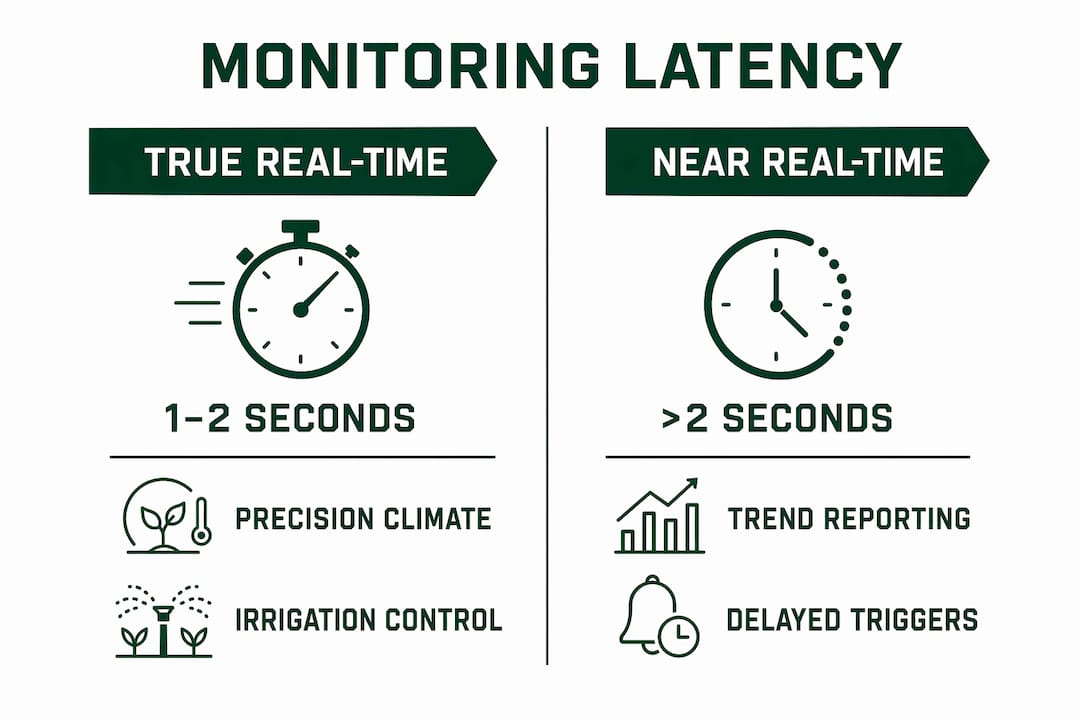
Near real-time systems work fine for weekly trend reports. They fall short when you need to trigger an irrigation valve or close a ventilation damper before a temperature threshold causes crop damage.
The technology underneath matters just as much as the numbers. Push-based platforms using WebSockets or Server-Sent Events (SSE) deliver data the moment a sensor registers a change. Polling-based systems, by contrast, check for new data on a fixed schedule. That schedule introduces lag. If your dashboard requires a manual refresh to show current conditions, you are running a polling system, not a live one.
Pro Tip: Ask your monitoring vendor directly: "Does your platform use WebSockets or SSE?" If they cannot answer, assume it is polling-based and verify latency independently before committing.
How does real-time monitoring differ from traditional monitoring?
Traditional monitoring relies on manual log checks, periodic sensor reads, or scheduled reports. The gap between a problem developing and a grower noticing it can stretch from minutes to hours. Modern automation reduces diagnosis time by 60–80% compared to manual checks or periodic reports. That compression in response time is the core operational advantage.
The practical benefits for your operation include:
- Faster troubleshooting. Live dashboards surface the exact sensor, zone, and timestamp of an anomaly. You are not hunting through log files.
- Fewer crop losses. Early signal alert badges flag anomalies before they reach the threshold where manual inspection would catch them. You get ahead of the problem.
- Better resource use. Continuous data lets you run irrigation and climate systems at actual crop demand rather than preset schedules. That reduces water and energy waste.
- Proactive risk management. You shift from reacting to crop stress after it appears to preventing it from developing at all.
Traditional monitoring misses anomalies lasting under 10 seconds entirely. In a greenhouse, a 10-second humidity spike near a disease-susceptible crop is not trivial. It is the kind of event that shows up two weeks later as a botrytis outbreak, and by then the connection to the original cause is invisible in your logs.
Michigan growers face specific pressure here. The state's variable spring and fall weather creates frequent outdoor temperature swings that affect greenhouse envelope performance. A live monitoring system catches those infiltration events as they happen, not after the next scheduled walk-through.
What advanced features should growers look for in a monitoring system?
The gap between a basic alert system and a genuinely useful monitoring platform comes down to three capabilities: predictive analytics, alert quality, and unified data visibility.
Predictive analytics using EWMA models
High-end agricultural operations use Exponentially Weighted Moving Average (EWMA) models to forecast environmental or equipment shifts 24–48 hours ahead. EWMA weights recent sensor readings more heavily than older ones, so the model responds to developing trends rather than reacting to single-point spikes. Automated Z-score threshold alerts then notify you when a reading deviates significantly from the predicted range. The result is a system that tells you a problem is forming before it arrives.
Alert configuration and debounce periods
Alert fatigue is a real operational problem. If your system sends a notification every time a sensor briefly crosses a threshold, you will start ignoring alerts. Debounce periods require a deviation to persist for 3–5 minutes before triggering a notification. That filter eliminates false positives from brief, non-critical fluctuations while preserving alerts for genuine sustained problems.
- Set your debounce window to match the crop's biological response time, not the sensor's sensitivity.
- Configure separate alert channels for critical faults (equipment failure, power loss) versus advisory conditions (humidity trending high).
- Review alert logs monthly and retire any alert that has never triggered a necessary response.
Unified observability across all data streams
Disparate monitoring tools make root cause analysis difficult. When your environmental sensors, irrigation system, and equipment status live in separate dashboards, correlating a crop stress event to its actual cause takes time you do not have. A unified platform surfaces all three data streams together, so you can see that the irrigation pump fault at 3:00 AM preceded the VPD spike at 3:15 AM and the leaf temperature anomaly at 3:30 AM. That sequence tells you exactly what happened and in what order.
Pro Tip: Before buying any monitoring platform, ask for a demo that shows environmental, irrigation, and equipment data on the same screen at the same time. If the vendor has to switch tabs to show you each one, that is a data silo.
How do you implement real-time monitoring without common mistakes?
Implementation quality determines whether your monitoring system actually protects your crop or just generates data you never act on. Most growers make the same four mistakes.
Common implementation mistakes
- Ignoring sensor latency. The sensor itself introduces delay before data even reaches your network. Sub-2 second total latency requires fast sensors, a reliable connection type (Wi-Fi, LoRaWAN, or cellular), and a push-based platform working together. One slow link breaks the chain.
- Using static dashboards. A dashboard that does not auto-refresh is not a monitoring tool. It is a report. Verify that your platform updates without any manual action on your part.
- Setting absolute thresholds only. A temperature of 85°F is a problem. But a temperature rising at 3°F per minute is a bigger problem, because it tells you where the reading will be in five minutes. Configure alerts based on rate of change, not just absolute values, to catch stress events before they peak.
- Managing siloed tools. Running separate apps for climate, irrigation, and equipment status forces you to mentally connect data that should be connected automatically. Unified observability is not a luxury feature. It is the difference between seeing a problem and understanding it.
What to verify before going live
| Check | Standard to meet |
|---|---|
| End-to-end latency | Under 2 seconds from sensor to dashboard |
| Data delivery method | Push-based (WebSocket or SSE confirmed) |
| Alert logic | Rate-of-change thresholds configured, not just absolute values |
| Data integration | Environmental, irrigation, and equipment data in one view |
| Alert debounce | Minimum 3-minute sustained deviation before notification |
Autonomous remediation is the final step most growers have not yet taken. A monitoring system that only alerts you still requires a human to act. A system with autonomous feedback loops adjusts irrigation valves or climate controllers directly, without waiting for your response. For Michigan operations running overnight or across multiple zones, that capability is what keeps yield consistent when no one is physically present.
Key takeaways
Continuous live data tracking with sub-2 second latency is the technical foundation that separates true real-time monitoring from the delayed snapshots most entry-level systems deliver.
| Point | Details |
|---|---|
| Latency standard | True real-time requires under 2 seconds from sensor to dashboard, not 5–30 seconds. |
| Push-based technology | Verify your platform uses WebSockets or SSE, not polling, for live data delivery. |
| Rate-of-change alerts | Configure alerts on how fast conditions are changing, not just fixed threshold values. |
| Unified data view | Combine environmental, irrigation, and equipment data in one dashboard to find root causes fast. |
| Autonomous remediation | Systems that act automatically on alerts protect yield overnight without requiring human response. |
Why most growers are still one step behind their data
I have worked with enough Michigan greenhouse and indoor farm operators to recognize a pattern. The monitoring system is running. The sensors are installed. The dashboard is live. And the grower is still reacting to problems instead of preventing them.
The issue is almost never the hardware. It is the configuration. Alerts set to absolute thresholds fire too late. Debounce periods are not set at all, so the phone buzzes at 2:00 AM for a 90-second humidity blip that resolved itself. Environmental data and irrigation data live in separate apps, so connecting a pump fault to a crop stress event requires manual detective work after the fact.
Real-time data is only as useful as the decisions it drives. The growers I have seen get the most out of continuous live tracking are the ones who treat alert configuration as an ongoing practice, not a one-time setup. They review which alerts fired, which ones mattered, and which ones were noise. They tighten the system over time.
The other shift that changes everything is autonomous remediation. When your monitoring platform can close a damper or adjust a valve without waiting for you to read an alert and respond, you stop being the bottleneck in your own operation. That is not a technology problem. It is a mindset shift. The data is there. The question is whether your system is built to act on it.
— Philip
Agriculturalautomationservices brings live monitoring to your grow operation
Michigan growers running greenhouses or indoor farms need monitoring that actually keeps pace with their crops.
Agriculturalautomationservices builds integrated automation systems that combine environmental sensors, irrigation controls, and climate management into a single unified monitoring platform. You get live data across every zone, push-based dashboards that update without manual refresh, and alert configurations built around your specific crop thresholds. The Assessment tier starts at $500 and gives you a clear gap analysis of your current setup before you commit to anything larger. If your operation is ready for full Design and Implementation, Agriculturalautomationservices scales from single-room facilities to multi-zone vertical farms. No guesswork about what you need. Just a clear plan built around your operation.
FAQ
What is the minimum latency required for real-time monitoring in agriculture?
True real-time monitoring requires end-to-end latency under 2 seconds from sensor detection to dashboard display. Systems with 5–30 second delays are classified as near real-time and are insufficient for precision irrigation or climate control triggers.
What is the difference between push-based and polling-based monitoring?
Push-based systems using WebSockets or SSE deliver data instantly when a sensor registers a change. Polling-based systems check for new data on a fixed schedule, introducing lag that makes them unsuitable for time-sensitive agricultural decisions.
How do I avoid alert fatigue in my monitoring system?
Configure debounce periods so alerts only fire after a deviation persists for 3–5 minutes. This filters out brief, non-critical fluctuations and keeps notifications meaningful.
Why should I set rate-of-change alerts instead of absolute thresholds?
Rate-of-change alerts detect a condition developing before it peaks, giving you time to respond before crop stress occurs. Absolute threshold alerts only notify you after the problem has already arrived.
What does autonomous remediation mean for a greenhouse operation?
Autonomous remediation means your monitoring system automatically adjusts equipment, such as irrigation valves or climate controllers, when conditions fall outside set parameters. It removes the human response delay and keeps conditions stable even when no one is physically present.